4k Resolution

4k resolution, which is also called as 4k, refers to a horizontal display resolution of 4,000 pixels. Digital television and digital cinematography both use several different resolutions of 4k. In television and consumer media, 3840 × 2160 (4K UHD) is the dominant 4K standard. In the movie projection industry, 4096 × 2160 (DCI 4K) is the dominant 4K standard. the 4k television share market has increased rapidly. By 2020, more than half of U.S. households are expected to have 4K-capable TVs,[3] a much faster adoption rate than that of Full HD (1080p).
History:-
The first commercially available 4K camera for cinematographic purposes was the Dalsa Origin, released in 2003. After that 4k technology was developed by many research group in universities, such as University of California, San Diego, CALIT2, etc. YouTube began supporting 4K for video uploads in 2010 as a result of leading manufacturers producing 4K cameras. In November 2013, YouTube began to use the VP9 video compression standard, saying that it was more suitable for 4K than High-Efficiency Video Coding (HEVC). Google, which owns YouTube, developed VP9. Theaters began projecting movies at 4K resolution in 2011. The first 4K home theater projector was released by Sony in 2012. Sony was offering 4K projectors as early as 2004. Sony is one of the leading studios promoting UHDTV content, as of 2013 offering a little over 70 movie and television titles via digital download to a specialized player that stores and decodes the video.
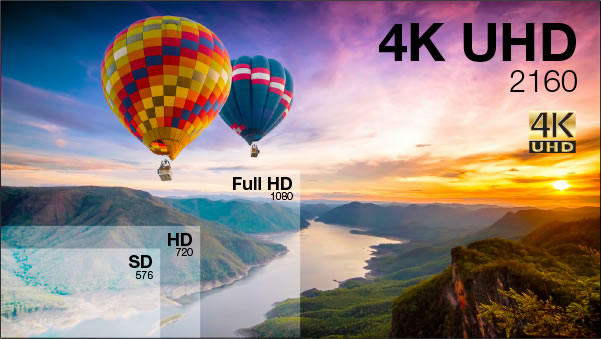
In 2014, Netflix began streaming House of Cards, Breaking Bad, and "some nature documentaries" at 4K to compatible televisions with an HEVC decoder. Most 4K televisions sold in 2013 did not natively support HEVC, with most major manufacturers announcing support in 2014. Amazon Studios began shooting their full-length original series and new pilots with 4K resolution in 2014. In March 2016 the first players and discs for Ultra HD Blu-ray—a physical optical disc format supporting 4K resolution and HDR at 60 frames per second—were released.
In 2016, Sony and Microsoft released the PlayStation 4 Pro and Xbox One S, respectively, both of which are video game consoles that support 4K streaming, although in most cases the resolution is upscaled to 4K; the Xbox One S also features an Ultra HD Blu-ray disc drive. On November 7, 2017, Microsoft released the Xbox One X, which is capable of native 4K streaming and gaming.
Resolutions:-
Examples of some 4K resolutions used in displays and media

_________________________________________________________________________________
|Format |resolutions | Aspect Ratio | Pixels |
|_____________________________|__________|_________________|________|_____________
| |4096 × 3072 | | |
| |4096 × 2560 | | |
| |4096 × 2304 | | |
| DCI 4K (full frame) |4096 × 2160 | ≈1.90∶1 (256∶135) |8,847,360 |
|DCI 4K (CinemaScope croppeed) |4096 × 1716 | ≈2.39∶1 (1024∶429)|7,020,544 |
|DCI 4K (flat cropped) |3996 × 2160 |1.85∶1 (999∶540) |8,631,360 |
|WQUXGA |3840 × 2400 |1.60∶1 (16∶10) |9,216,000 |
|4K UHD |3840 × 2160 |1.77∶1 (16∶9) |8,294,400 |
| |3840 × 1600 |2.40∶1 (12∶5) |6,144,000 |
| |3840 × 1080 |3.55∶1 (32∶9) |4,147,200 |
___________________________________________________________________________________
Other 4K resolutions:-
History:-
The first commercially available 4K camera for cinematographic purposes was the Dalsa Origin, released in 2003. After that 4k technology was developed by many research group in universities, such as University of California, San Diego, CALIT2, etc. YouTube began supporting 4K for video uploads in 2010 as a result of leading manufacturers producing 4K cameras. In November 2013, YouTube began to use the VP9 video compression standard, saying that it was more suitable for 4K than High-Efficiency Video Coding (HEVC). Google, which owns YouTube, developed VP9. Theaters began projecting movies at 4K resolution in 2011. The first 4K home theater projector was released by Sony in 2012. Sony was offering 4K projectors as early as 2004. Sony is one of the leading studios promoting UHDTV content, as of 2013 offering a little over 70 movie and television titles via digital download to a specialized player that stores and decodes the video.
In 2014, Netflix began streaming House of Cards, Breaking Bad, and "some nature documentaries" at 4K to compatible televisions with an HEVC decoder. Most 4K televisions sold in 2013 did not natively support HEVC, with most major manufacturers announcing support in 2014. Amazon Studios began shooting their full-length original series and new pilots with 4K resolution in 2014. In March 2016 the first players and discs for Ultra HD Blu-ray—a physical optical disc format supporting 4K resolution and HDR at 60 frames per second—were released.
In 2016, Sony and Microsoft released the PlayStation 4 Pro and Xbox One S, respectively, both of which are video game consoles that support 4K streaming, although in most cases the resolution is upscaled to 4K; the Xbox One S also features an Ultra HD Blu-ray disc drive. On November 7, 2017, Microsoft released the Xbox One X, which is capable of native 4K streaming and gaming.
Resolutions:-
Examples of some 4K resolutions used in displays and media
_________________________________________________________________________________
|Format |resolutions | Aspect Ratio | Pixels |
|_____________________________|__________|_________________|________|_____________
| |4096 × 3072 | | |
| |4096 × 2560 | | |
| |4096 × 2304 | | |
| DCI 4K (full frame) |4096 × 2160 | ≈1.90∶1 (256∶135) |8,847,360 |
|DCI 4K (CinemaScope croppeed) |4096 × 1716 | ≈2.39∶1 (1024∶429)|7,020,544 |
|DCI 4K (flat cropped) |3996 × 2160 |1.85∶1 (999∶540) |8,631,360 |
|WQUXGA |3840 × 2400 |1.60∶1 (16∶10) |9,216,000 |
|4K UHD |3840 × 2160 |1.77∶1 (16∶9) |8,294,400 |
| |3840 × 1600 |2.40∶1 (12∶5) |6,144,000 |
| |3840 × 1080 |3.55∶1 (32∶9) |4,147,200 |
___________________________________________________________________________________
Other 4K resolutions:-
- 4096 × 2560
- 4096 × 2304
- 3840 × 2400
- 3840 × 1600
- 3840 × 1080
Some Movie Scene In 4k:-